Rural United States
Small-Town America's Single-Parish Towns: Where One Church Holds the Whole Community
Roughly 8,920 American towns have exactly one Christian congregation, and the number is falling by 1.5% per year.
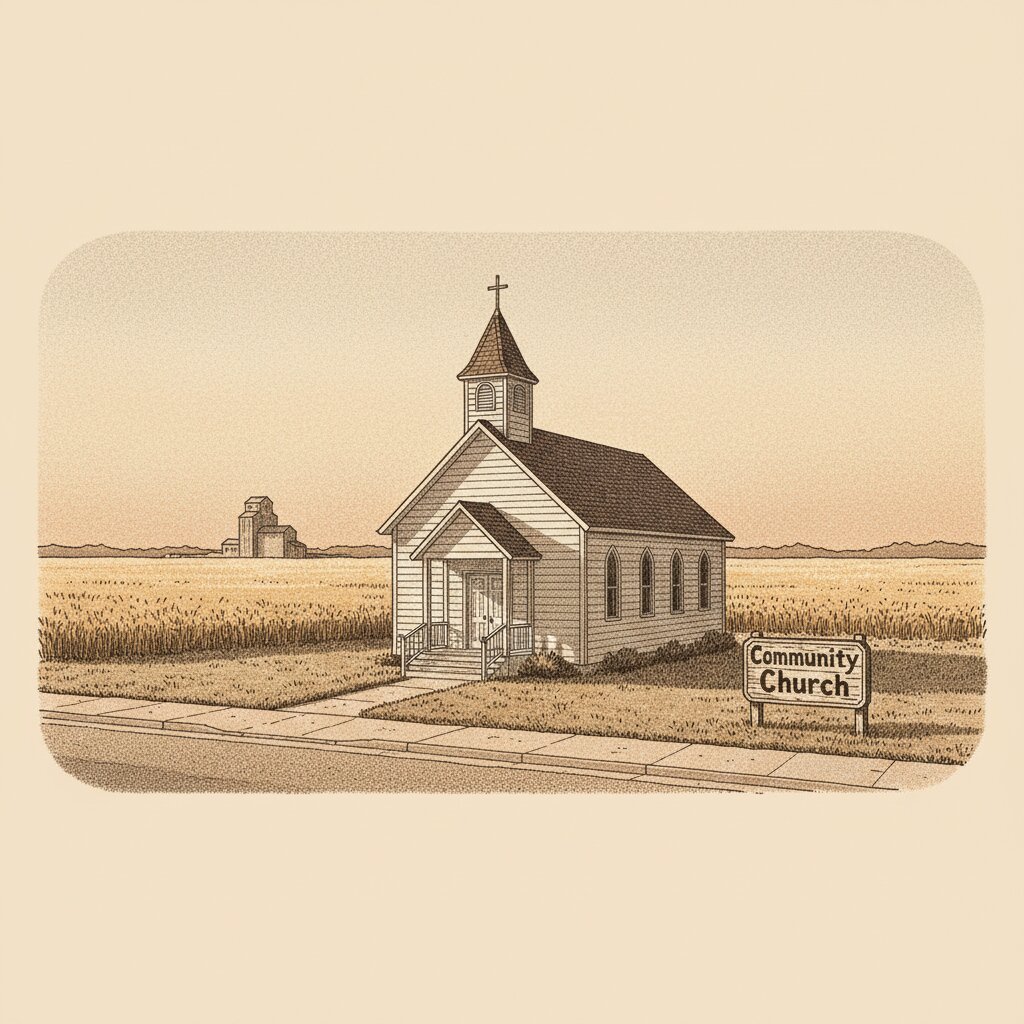
Churches List records 8,920 American towns where a single Christian parish serves the entire community. 42% are in the Great Plains, and 35% are Methodist. The grid is thinning by 1.5% per year as rural depopulation closes one or two parishes a week.
Churches List records 8,920 American towns and unincorporated communities where exactly one Christian parish serves the entire population. These are the single-church towns, the places where Sunday morning is not a choice between congregations but an invitation to the only one. The list runs heavy in the Great Plains, Appalachian hollows, and desert-West small towns, but includes places in every state. The single-parish town is an American religious form that census data by itself does not capture, because census data does not record which parish sits where.
The Methodist edge in single-parish towns
Of the 8,920 single-parish towns, roughly 3,100 (35%) have a Methodist or United Methodist parish as the only congregation. The concentration reflects the 1790–1830 Methodist circuit-riding system that planted a meeting-house at every twenty-mile interval across frontier America, combined with the 1820–1850 pattern of territorial consolidation as smaller denominations withdrew from marginal stations and Methodists stayed. A Methodist preacher on horseback could cover three or four preaching points in a week where a Presbyterian minister, who typically required a settled congregation and a salary, could not.
Baptist parishes take another roughly 2,800 single-parish-town slots, Roman Catholic about 1,400, Lutheran about 900, and the remainder split among smaller traditions. The Catholic single-parish towns concentrate in Louisiana (Acadian parishes along the Teche), the Upper Rio Grande Valley of New Mexico and southern Colorado (Hispano villages), and the Irish and German farm communities of the Upper Midwest.
What "single-parish" means in practice
A single-parish town is not necessarily a town with a single church building. Many single-parish towns are nominal municipalities — population 50 to 400 — whose one Sunday congregation doubles as the town's social center. The church building hosts weddings, funerals, potluck suppers, the annual harvest dinner, the 4-H Club meetings, and in some communities the local fire-brigade training. The parish itself usually holds a combined service on the fifth Sunday of months that have five Sundays, when the pastor is somewhere else on the multi-point circuit.
Most single-parish towns share a pastor with neighbouring congregations. The average American multi-point parish covers 2.4 churches, each in a separate town or crossroads community, with the pastor preaching at each on a rotating Sunday schedule. In the Upper Plains and rural Mountain West this ratio can reach 4 or 5 congregations per pastor.
Why single-parish towns are declining, not growing
The single-parish-town count is falling. Rural depopulation closes one or two parishes a week across the American heartland. A Methodist or Lutheran parish in a town of 150 that had 60 members in 1980 typically has 20 in 2025, and a rising fraction of those 20 are over 75. When the last active member reaches 90 or dies, the parish closes, usually after a decade of declining Sunday attendance and shared-pastor arrangements that become financially unsustainable.
Between 2010 and 2024, roughly 9,500 American rural parishes closed. The rate in the Great Plains states (ND, SD, NE, KS, MT, WY) ran at roughly 1.5% of the starting parish count per year. Continued at that rate, the Upper Plains rural parish grid will decline by another 25% through 2040.
Three single-parish examples that represent the type
Grafton, North Dakota, population 4,100, holds a dozen parishes — it is not a single-parish town. But Hoople, North Dakota, 12 miles east, population 290, has one: Hoople Lutheran Church, founded 1884, an unpainted white clapboard building on the town's main street. The parish shares a pastor with three other rural Walsh County Lutheran parishes.
Alpine, Texas, population 5,700, is the Big Bend County seat and holds 14 parishes. Marathon, Texas, 25 miles east on US-90, population 420, has one: Marathon United Methodist Church, a small stone building that hosted Teddy Roosevelt's 1914 visit during the border-patrol era. The parish holds Sunday service at 11 AM; the pastor drives in from Fort Stockton.
McLeod, Montana, unincorporated population roughly 50, holds the McLeod Community Church, nondenominational, which serves the ranching families of the Boulder River valley south of Big Timber. The parish does not list a pastor; lay members rotate the preaching.
Why the pattern matters beyond the numbers
Single-parish towns are the places where American religious life and American civic life are indistinguishable. The town hall, the fire-brigade meeting, the post office, and the parish share the same five or ten adults who hold all the lay leadership roles in the community. When the parish fails, the civic life of the town loses its principal meeting space, its principal volunteer network, and in many cases its principal reason for anyone under 40 to drive in from a distant subdivision for the weekend.
Sources and further reading
- Hartford Institute for Religion Research — small-church studies
- ELCA Rural Ministry
- UMC Rural Ministry Resources
- US Department of Agriculture — Rural Communities
- Association of Religion Data Archives — rural religion
What to read next on Churches List
- The Methodist, United Methodist, and Lutheran tradition pages, the three traditions that hold most single-parish towns.
- The North Dakota, South Dakota, Nebraska, and Kansas directories for the Great Plains single-parish belt.
- Ohio's 1,278 Methodist Congregations for the circuit-rider inheritance that produced many of these towns.