Pittsburgh, Pennsylvania
Pittsburgh's 721 Parishes and the Industrial Catholic Arc: Slovak, Polish, Italian, and German Congregations
The last American city where an ethnic-parish Catholic name still maps a neighbourhood's founding population.
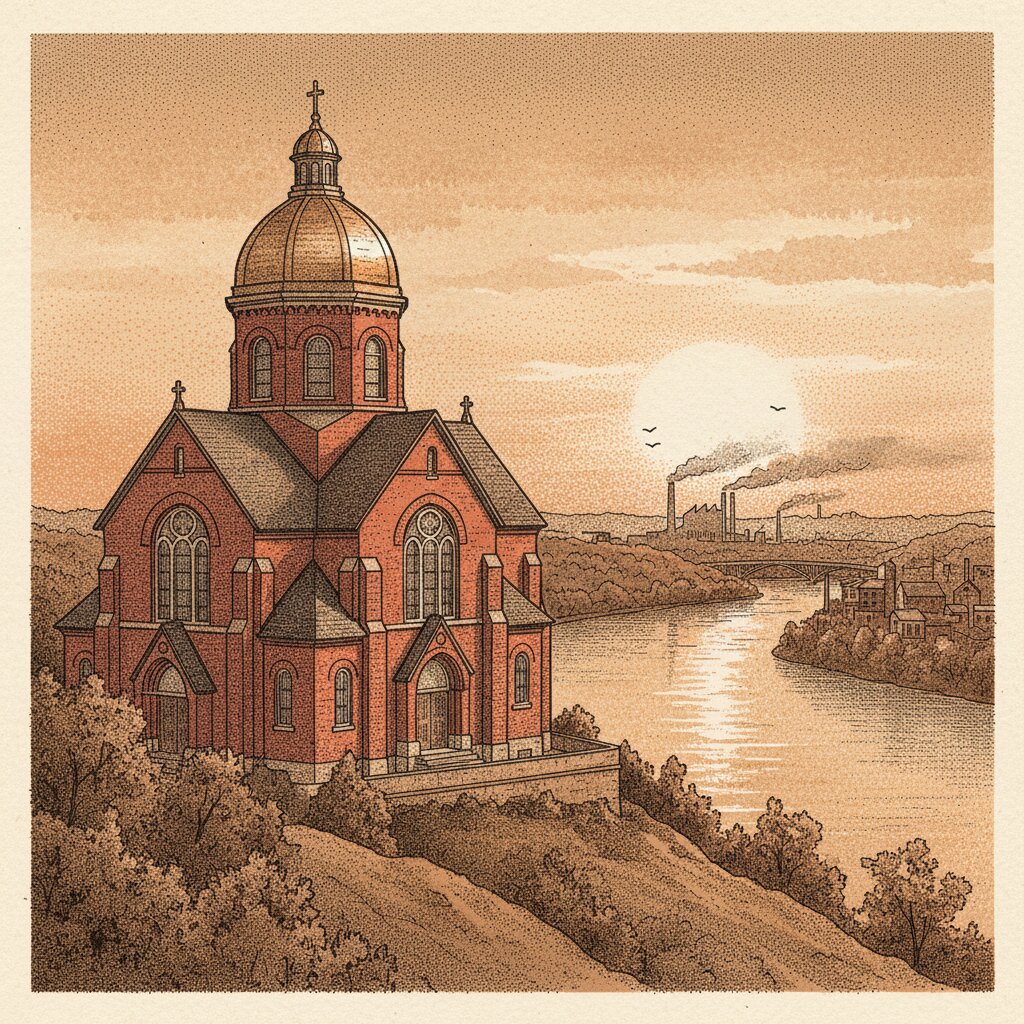
Pittsburgh holds 721 parishes, with 180 Roman Catholic and at least 25 Eastern-Rite (Byzantine) Catholic parishes clustered around former steel-mill neighbourhoods. The parish names still read as a census of the 1890–1920 industrial workforce.
Pittsburgh holds 721 parishes inside the city limits and several hundred more across Allegheny County. The city's Roman Catholic parish count alone runs near 180, concentrated in the Strip District, Lawrenceville, the South Side, Hazelwood, the Hill District, and Polish Hill. The ethnic tell is unusually precise: parish names carry the immigrant national origin in a way that few other American Catholic cities still preserve. Pittsburgh is the last American city where a Catholic traveler can read the neighbourhood's founding population off the church doorplate.
The Polish cluster: St. Stanislaus, St. Adalbert, St. John Cantius
The Polish Catholic parish cluster runs from the Strip District east through Lawrenceville, Bloomfield, and Polish Hill (the neighbourhood actually took its name from the parish).
The Slovak, Czech, and Hungarian layer
Pittsburgh's Slovak Catholic parish grid is one of the most complete outside Slovakia itself. Saint John Nepomucene in the South Side, the former St. Matthew's in the Strip, and St. Elizabeth of Hungary in Pleasant Hills served the Slovak and Hungarian workforce of the Jones & Laughlin, Carnegie, and US Steel operations.
The Italian Catholic parishes: Bloomfield and Panther Hollow
Italian Catholics settled Bloomfield, East Liberty, and Panther Hollow (the shanty settlement at the edge of Oakland that became the original Italian neighbourhood before dispersing northward). Parishes like Immaculate Conception in Bloomfield and St. Joseph in the Bloomfield-Liberty corridor carried the Italian community's Sunday Mass schedule through the twentieth century. Many are now administered through merged pastoral groupings.
The Byzantine-Rite and Ruthenian Catholic presence
Pittsburgh holds one of the densest concentrations of Eastern-Rite (Byzantine) Catholic parishes in the United States. The Byzantine Catholic Archeparchy of Pittsburgh, created in 1963, covers the Ruthenian Byzantine Catholic Church in the United States, and its chancery sits in Pittsburgh.
The German Catholic parishes and the Passionist monastery
German Catholics settled the South Side Slopes, Mount Washington, and the Hill District. St. Michael's in the South Side (closed 2008, building preserved) and Holy Innocents served the German parish population through the mill era. The Passionist monastery of St. Paul of the Cross at 148 Monastery Avenue on Mount Washington, founded 1853, is the oldest Passionist foundation in the United States and one of the oldest monasteries west of the Atlantic Seaboard. The community operates the Mission Church (the large gold-domed church on the Mount Washington overlook) and continues the Passionist retreat ministry.
The African-American Catholic parishes: St. Benedict the Moor
The Hill District's Black Catholic community is served principally by St. Benedict the Moor parish, named for the 1524 Ethiopian Franciscan saint. The parish is representative of a narrow but significant American Catholic tradition: Black Catholic parishes founded during the Great Migration to serve populations that the existing ethnic-origin parishes did not welcome. Pittsburgh's Hill District parish is paired in the diocese with a similar parish in the Homewood neighbourhood.
Why the ethnic tell persists in Pittsburgh
Most American Catholic dioceses abandoned the national-parish model by 1930. A Polish family moving to a new American city in 1950 was assigned to a territorial (geography-based) parish rather than to a Polish national parish. Pittsburgh, along with Buffalo, Chicago, Detroit, and Milwaukee, resisted that trend later than most because the industrial workforce kept arriving in ethnically-coherent waves into the 1920s. The Pittsburgh diocese's 2020 consolidations technically ended the national-parish administration, but the buildings are still open and the parish names still carry the original ethnic designation.
Sources and further reading
- Diocese of Pittsburgh
- Byzantine Catholic Archeparchy of Pittsburgh
- Ukrainian Catholic Eparchy of St. Josaphat in Parma
- Passionists of Holy Cross Province
- Senator John Heinz History Center
What to read next on Churches List
- The Pittsburgh city page holds all 721 parishes across every tradition.
- The Catholic tradition page indexes every Catholic parish nationally.
- The Patron-Saint Portfolio for the broader patterns of American Catholic parish naming.