Louisiana

The Louisiana Catholic Corridor: 764 Parishes and the French Colonial Map That Shaped Them

Louisiana's southern two-thirds holds 700 of the state's 764 Catholic parishes on a grid that has not redrawn since 1803.
4 minute read Churches List editorial desk

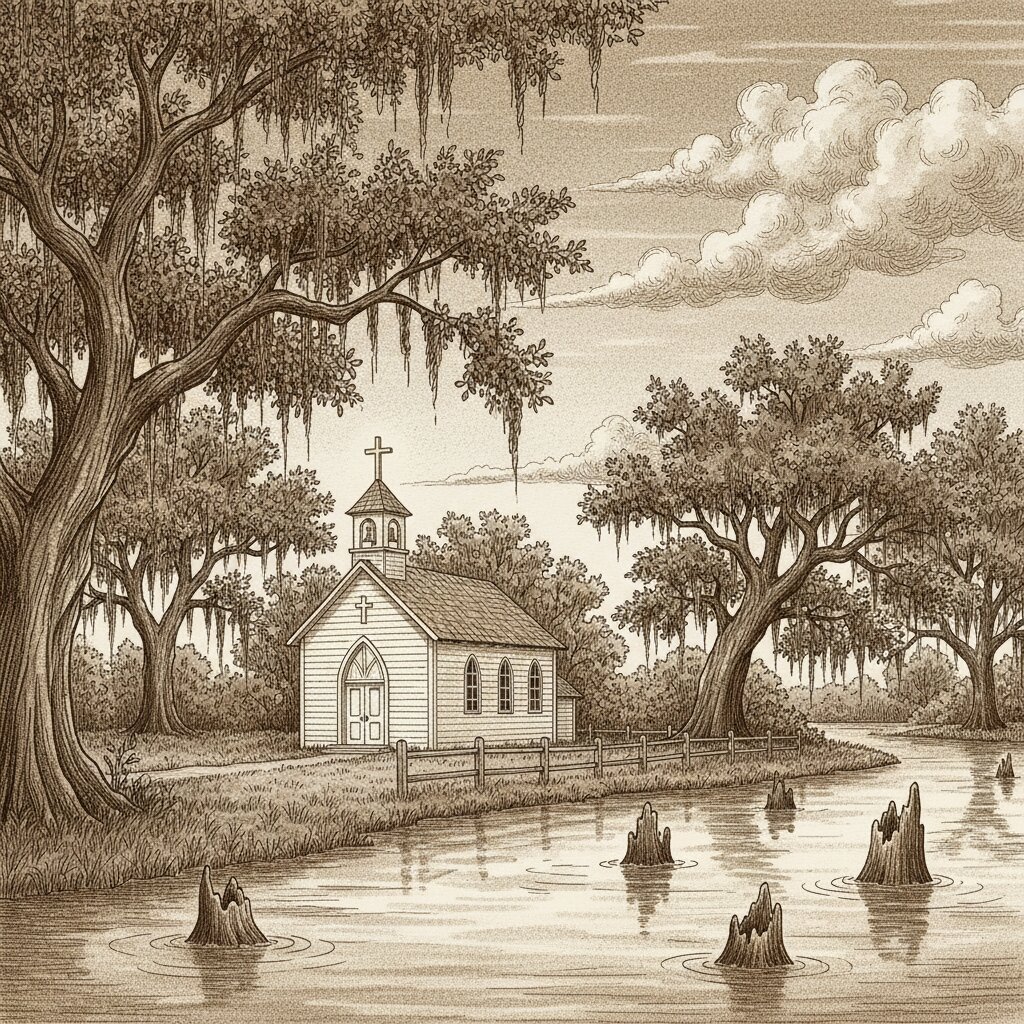
Illustration of a small white clapboard Louisiana Catholic chapel beside a bayou at dusk, with Spanish moss in the oaks and a wooden rail fence in the foreground.

Louisiana records 764 Roman Catholic parishes in the Churches List directory, a concentration unique south of the Ohio. The southern two-thirds of the state still sits on the French colonial mission grid laid out between 1699 and 1763.

Louisiana holds 764 Roman Catholic parishes in the Churches List state directory, a concentration that is unique among American states south of the Ohio River. Louisiana's Catholic share of its Christian parish total is roughly 24%, more than double the Southern average of 11%. The reason is cartographic. French colonial settlement between 1699 and 1803 placed Catholic missions along every bayou, levee, and river bend in the southern two-thirds of the state, and the 1803 Louisiana Purchase did not unwind that grid.

764Louisiana Catholic parishes (Churches List)
1699First permanent French mission at Fort Maurepas
7Catholic dioceses inside Louisiana

The southern two-thirds of the state is Catholic; the northern third is Baptist

A line drawn from Alexandria southwest to Lake Charles, then east along Interstate 10 to the Mississippi state line, separates Catholic Louisiana from Baptist Louisiana. South of that line the Catholic parish grid is continuous: every parish seat (Louisiana uses "parish" for its civil counties, and the political term inherits from the ecclesiastical) has at least one Roman Catholic church in its town center. North of the line the Catholic presence falls to the sub-10% range of neighbouring Mississippi and Arkansas, and the Southern Baptist Convention dominates.

The Louisiana dioceses follow that same split. The Archdiocese of New Orleans and the Dioceses of Baton Rouge, Lafayette, Houma-Thibodaux, and Lake Charles together cover the southern Catholic corridor. The Diocese of Alexandria covers the transitional middle. The Diocese of Shreveport covers the Baptist-majority north.

New Orleans and the Jesuit Church: the Immaculate Conception on Baronne Street

Immaculate Conception Church at 130 Baronne Street, known locally as the Jesuit Church, sits two blocks from the edge of the French Quarter. The parish is the New Orleans anchor of the Society of Jesus in Louisiana. The present Moorish Revival building, with its horseshoe arches and ornate cast-iron columns, was finished in 1930 to replace an 1857 original that had settled into the soft river-delta soil. The 1930 structure copied the original facade closely. Sunday Mass is offered in Latin (Ordinary Form) at 11:00 AM and in English at 7:30, 9:30, and 5:00 PM.

Houma-Thibodaux and St. Francis de Sales Cathedral

St. Francis de Sales Cathedral at 500 Goode Street, Houma, is the seat of the Diocese of Houma-Thibodaux, created in 1977 from the lower reaches of the Archdiocese of New Orleans. Houma serves as the Catholic hub for the Louisiana coastal parishes of Terrebonne and Lafourche. The cathedral holds roughly 650 registered families and Mass is offered in English, French, and Vietnamese — the last reflecting the 1975 resettlement of South Vietnamese Catholic fishing families into the Terrebonne-Lafourche shrimp industry, one of the largest single Vietnamese Catholic communities in the American South.

St. Peter's, New Iberia: the Teche corridor's Acadian Catholic anchor

St. Peter's Catholic Church at 101 West St. Peter Street, New Iberia, serves Iberia Parish along the Bayou Teche. The congregation was founded in 1838 to serve the Acadian French-speaking population that had been deported from Nova Scotia by the British in 1755 and that resettled in the Teche country between 1764 and 1785. The parish still offers a Cajun French Mass on the second Sunday of each month. New Iberia's Catholic population, at roughly 40% of the town, is a direct demographic descendant of that Acadian resettlement.

Lafayette and the Immaculate Heart of Mary: the Acadian capital's principal parish

Immaculate Heart of Mary Church in Lafayette serves the de facto capital of Acadian Louisiana. The Diocese of Lafayette, erected in 1918 and elevated to an archdiocese in 2002 (then demoted back in 2008 over a canon-law technicality), holds the densest Catholic-per-capita share of any American Catholic see outside the archdioceses of Santa Fe and San Antonio. Lafayette's Catholic share passes 55% in the 2020 census religious adherents study.

Opelousas and Holy Ghost: the Black Catholic parish of St. Landry Parish

Holy Ghost Catholic Church at 747 North Union Street, Opelousas, is one of the largest historically Black Catholic parishes in the United States. The parish was founded in 1919 for the Creole-Catholic community of St. Landry Parish, a population whose ancestry mixes French, Spanish, African, and Native Choctaw roots and that holds Catholic affiliation at rates far higher than the surrounding Black Protestant region. Holy Ghost lists more than 4,000 registered families.

Baton Rouge and St. Jean Vianney: the university-era parish

St. Jean Vianney Catholic Church in Baton Rouge sits on Jefferson Highway southeast of the LSU campus. The parish was founded in 1961 to serve the post-war suburban expansion of Baton Rouge south of the State Capitol district. Unlike the Teche and Lafayette parishes, St. Jean Vianney has no Acadian or Creole lineage; it is a mid-century planted parish that reflects the twentieth-century Catholic suburbanization of Louisiana's middle-class parishes.

Louisiana's 764 Catholic parishes are not evenly distributed across the state. The southern two-thirds holds roughly 700 of them, on a grid laid out by French missionaries between 1699 and 1763 and reinforced by the 1755 Acadian deportation.

Sources and further reading

What to read next on Churches List