United States
The Patron-Saint Portfolio: What Church Names Reveal About Where American Catholics Came From
The saint on the doorpost is the nineteenth-century immigrant community's signature. Read the name, read the origin.
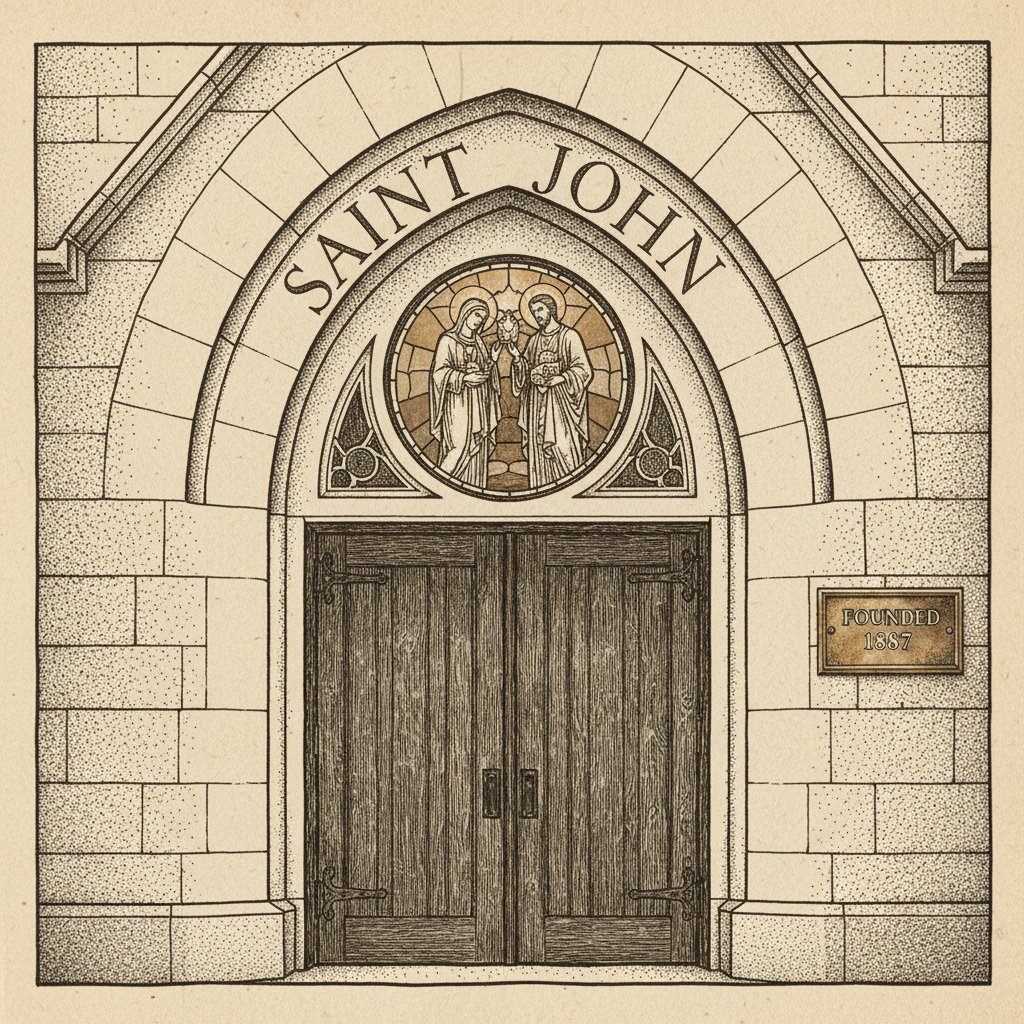
American parishes carry 3,917 St. John dedications, 3,334 St. Paul, 2,347 St. Mary, 1,714 Our Lady, and 97 St. Stanislaus. Each name is an immigrant community's signature on its American doorpost.
The most common American parish name is not "First Baptist" or "Trinity Church" but a variation on the name of a saint. Churches List records 3,917 American parishes whose name begins "St. John" or "Saint John," 3,334 dedicated to St. Paul, 2,347 to St. Mary, 1,714 beginning "Our Lady," and 1,610 to St. Joseph. The pattern holds across Roman Catholic, Orthodox, Anglican, and Lutheran traditions; what varies is which saint a given immigrant community carried with them and nailed to the door of its first American sanctuary.
St. John: the most common patron in the United States
"St. John" covers at least four different patrons: John the Baptist (the Forerunner of Christ), John the Apostle (the author of the Fourth Gospel), John Chrysostom (the Greek patriarch), and John Vianney (the Curé of Ars). Roman Catholic parishes named "St. John the Baptist" tend to appear in French Canadian, German, and Polish immigrant settlements; Orthodox parishes named "St. John Chrysostom" mark Greek or Byzantine-Rite communities; and the more modern "St. John Vianney" parishes (the curé was canonized in 1925) usually indicate a postwar suburban planting.
St. Paul: the 3,334-parish spread across traditions
St. Paul shows up in Catholic, Lutheran, Methodist, and many Orthodox parish names. Lutheran parishes particularly favour Paul, whose emphasis on salvation by faith through grace is the theological anchor of the Lutheran Reformation. The Evangelical Lutheran Church in America alone holds more than 1,100 "St. Paul" congregations. Roman Catholic use of St. Paul as a patron is narrower, typically tied either to the Pauline fathers (a specific religious order) or to missionary parishes.
St. Mary: 2,347 parishes and the geographical test of Catholic ethnic origin
American parishes named "St. Mary" typically signal a Catholic congregation, though Orthodox and some Anglican parishes use the name. The useful signal is the modifier. "St. Mary of the Assumption" usually indicates a German Catholic parish. "St. Mary of the Immaculate Conception" usually indicates an Irish Catholic parish (the doctrine was defined in 1854, during the peak Irish wave). "St. Mary of the Mount" often indicates an Italian Catholic parish. "St. Mary of the Angels" indicates a Franciscan-staffed parish of any ethnic origin.
St. Stanislaus: the 97-parish Polish tell
Only 97 parishes in our directory begin "St. Stanislaus." Almost every one is a Polish Catholic parish, and almost every one sits in a city that had a nineteenth-century Polish immigrant population: Chicago (St. Stanislaus Kostka in the old Polish Downtown), Pittsburgh (St. Stanislaus on Smallman Street in the Strip District), Detroit, Milwaukee, Buffalo, and the anthracite coal towns of Pennsylvania's Schuylkill and Luzerne counties. The presence of a St. Stanislaus parish in an American city is a near-perfect proxy for the nineteenth-century Polish industrial workforce.
St. Patrick: 734 parishes across the Irish migration map
"St. Patrick" parishes map the Irish Catholic migration almost exactly. The densest concentrations are in Boston, New York (including the 1809 St. Patrick's Old Cathedral at 263 Mulberry Street, predecessor to the 1879 Fifth Avenue cathedral), Philadelphia, Chicago, and the mining towns of Pennsylvania, Montana, and Colorado. A parish named "St. Patrick" founded before 1880 is almost certain to be an Irish Catholic parish; one founded after 1950 may well be a suburban planting with no ethnic signal beyond the name.
Sacred Heart: 1,112 parishes and the French devotional tradition
"Sacred Heart of Jesus" or "Sacred Heart" as a parish name usually indicates a French Catholic or French Canadian origin. The devotion was popularized by the 1673 visions of St. Margaret Mary Alacoque at Paray-le-Monial in Burgundy and spread through the French-speaking Catholic world from the 1700s. Sacred Heart parishes cluster in Louisiana (French Creole), northern New England (French Canadian), Detroit, and parts of the Upper Midwest settled by French Canadians during the logging and paper-mill era.
Holy Family, Holy Trinity, Holy Cross: the non-saint patrons
Roughly 2,200 American parishes use a non-saint dedication: Holy Family (379), Holy Trinity (726), Holy Cross (400+), Holy Name of Jesus, Most Precious Blood. These dedications are less ethnically specific than saint names. "Holy Family" in particular became a common twentieth-century Catholic parish name because it avoids the ethnic-specificity problem that diocesan consolidators wanted to sidestep after 1950.
Our Lady: 1,714 Marian parishes that encode place
"Our Lady of Guadalupe" indicates a Mexican or Chicano Catholic parish. "Our Lady of Fatima" indicates a Portuguese or Cape Verdean parish. "Our Lady of Lourdes" indicates a French or later twentieth-century general-Catholic parish. "Our Lady of Czestochowa" is an unmistakable Polish signal. "Our Lady of Perpetual Help" was popularized by the Redemptorist order and often indicates a Redemptorist-staffed parish. The specificity of the Marian invocation is the most precise ethnic-origin test in the American Catholic parish-name system.
Sources and further reading
- Vatican — Roman Martyrology
- Catholic Encyclopedia (New Advent)
- Library of Congress — Immigration and Relocation in American History
- US Conference of Catholic Bishops
What to read next on Churches List
- The Catholic tradition page indexes all 25,275 American Catholic parishes.
- The Orthodox tradition page holds the Greek, Russian, Ukrainian, and other Eastern-Rite parishes where St. John Chrysostom, St. George, and St. Nicholas names concentrate.
- The Louisiana Catholic Corridor for a deep look at how French colonial settlement mapped Sacred Heart, St. Martin, and St. Joseph across the bayou country.