Ohio
Ohio's 1,278 Methodist Congregations: Why the Circuit System Still Maps the State
A 1790s circuit-riding map drawn by Francis Asbury still describes where Sunday Methodist worship happens in Ohio.
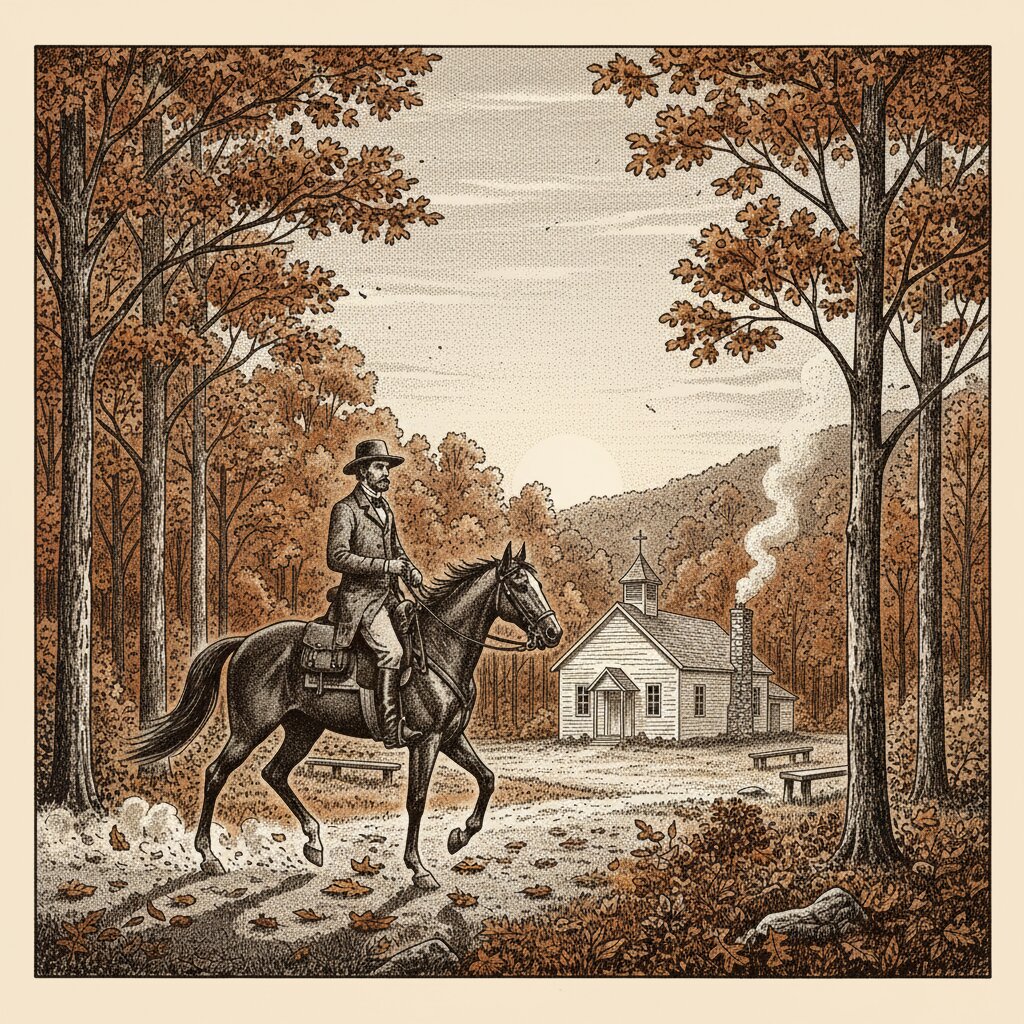
Ohio holds 1,278 Methodist and United Methodist congregations, the highest state Methodist density in the country. The grid traces to the 1790–1830 circuit-riding preachers who planted a meeting-house every twenty miles across the Ohio country.
Ohio records 1,278 Methodist and United Methodist congregations, the highest Methodist density of any American state. The grid traces almost exactly to the circuit-riding preachers who mapped the Ohio country between 1790 and 1830. A circuit rider covered a route of 200 to 400 miles on horseback, preaching at two or three cabins a day, and planted a meeting-house every twenty miles or so. Most of the Methodist parishes founded on those circuits still operate, which is why Ohio's Methodist parish-per-square-mile count is higher than Minnesota's Lutheran or Texas's Baptist.
The circuit rider and the twenty-mile meeting-house
Francis Asbury, the first American Methodist bishop, rode the Ohio country personally between 1787 and 1810. The circuit system he organized placed each Methodist preacher in charge of a geographic route rather than a single congregation. A typical Ohio circuit in 1820 held 15 to 30 preaching stations, each with a small log or frame meeting-house, and the preacher cycled through the circuit every four to six weeks. The stations that drew enough members to afford a settled pastor graduated into full parishes; the others stayed as circuit points, many of them absorbed into one of their neighbours after the Civil War.
The remnant of that system is still visible in Ohio's rural Methodist geography. Drive any state route south of I-70 and a Methodist parish appears every ten to fifteen miles, most of them with a founding date between 1815 and 1845. The 1960 interstate system did not unwind the grid; it overlaid it.
Columbus as the Methodist metropolitan centre
Columbus holds roughly 150 Methodist and United Methodist parishes inside the city limits, more than any other Ohio city. The distribution is not a function of Methodist missionary success in central Ohio; it reflects Methodist adaptability to the state-capital growth pattern. Columbus grew more slowly than Cleveland or Cincinnati in the nineteenth century and more rapidly after 1950, and Methodist parishes scaled with that later wave.
The 2020–2024 UMC disaffiliation and Ohio's share
The disaffiliation wave that moved roughly 25% of American UMC congregations into the newly-formed Global Methodist Church hit Ohio at a rate slightly below the national average. About 19% of Ohio's UMC parishes left the denomination between 2020 and 2024, most to join the Global Methodist Church or to go independent. The departures were concentrated in the state's southern and southeastern counties (the Appalachian fringe). Urban Columbus, Cleveland, and Cincinnati parishes overwhelmingly stayed in the UMC.
Epworth and the Toledo Methodist cluster
Maple Grove, North Broadway, Bethel: the suburban Columbus wave
Columbus's suburban Methodist parishes include
Church for All People: the Methodist-Anglican-Community-Action hybrid
Sources and further reading
- United Methodist Church — denominational site
- United Methodist General Commission on Archives and History
- Methodist Theological School in Ohio
- Global Methodist Church
- West Ohio Conference of the UMC
What to read next on Churches List
- The Ohio directory lists every Methodist parish across the state's 88 counties.
- The Methodist tradition and United Methodist tradition pages for the two separately-indexed Methodist traditions.
- The Baptist–Lutheran Inversion for a related look at how American Protestant traditions divide the map.