United States
The Baptist–Lutheran Inversion: Where the Two Traditions Trade Places on the Lower-48 Map
Nine states record more Lutheran than Baptist congregations. The remaining thirty-nine are Baptist by four-to-one or more.
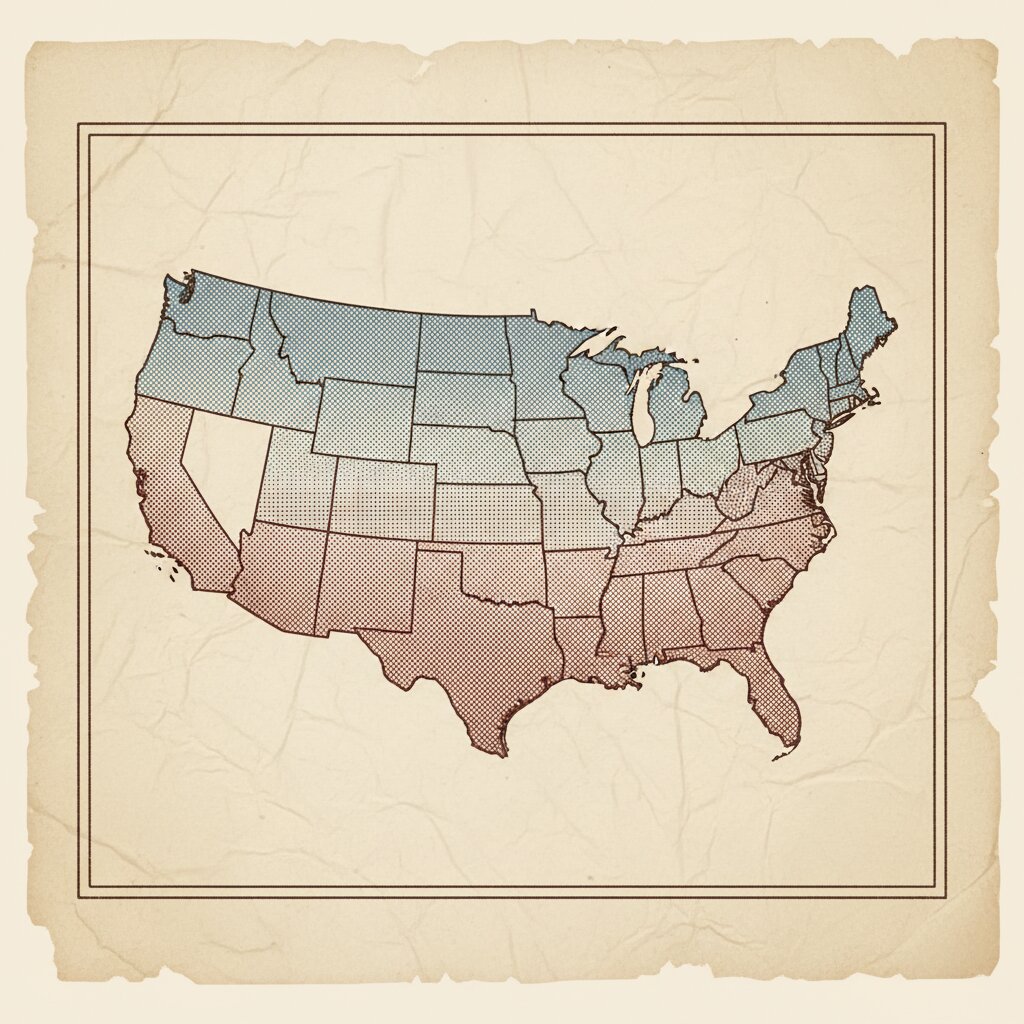
American Baptist (74,720 congregations) and American Lutheran (17,216) divide the lower 48 along a diagonal from Mobile to Fargo: nine states are Lutheran-dominant, and the rest are Baptist-dominant by four-to-one ratios or wider.
American Baptist and American Lutheran congregations divide the United States along a diagonal line that runs from Alabama to North Dakota. Churches List records 74,720 Baptist congregations and 17,216 Lutheran congregations nationally. The two traditions almost never share a state as their largest Protestant bloc: the country splits cleanly into a Baptist South and a Lutheran Upper Midwest, with a narrow neutral band through Iowa, Illinois, and Ohio.
Nine states where Lutheran congregations outnumber Baptist
Only nine states in the continental 48 record more Lutheran than Baptist congregations in our directory: Minnesota (1,758 Lutheran vs 443 Baptist), Wisconsin (1,465 vs 486), North Dakota (462 vs 102), Iowa (758 vs 466), Nebraska (523 vs 243), South Dakota (349 vs 126), Montana (169 vs 196 — a narrow reversal), and pockets of Washington and Michigan where the two sit within 10%. The inversion tracks the nineteenth-century German and Scandinavian migration lines almost exactly. Minnesota was 40% foreign-born by 1900, most of it Norwegian, Swedish, and German Lutheran.
The Norwegian Lutheran concentration in Minnesota and the Dakotas produced one of the densest rural church grids in American religious history. An 1890 county plat map of Otter Tail County, Minnesota, shows a Lutheran parish at nearly every township boundary, one per six-square-mile grid, each with a small cemetery behind it. Most of those buildings stand.
The Baptist dominant states: Texas holds 7,185 Baptist congregations
Texas's Baptist-to-Lutheran ratio is close to ten to one: the Texas directory lists 7,185 Baptist parishes against 746 Lutheran. In the Deep South the ratio widens further. Mississippi records 3,145 Baptist congregations and 41 Lutheran, a ratio of 77 to 1. The other Baptist-dominant states run in the same register: North Carolina (5,772 vs 296), Georgia (5,445 vs 144), Alabama (4,047 vs 87), Tennessee (3,574 vs 111), and Louisiana (3,187 vs 84).
The Baptist belt is an artifact of the Second Great Awakening, not of immigration. The Methodist and Baptist circuit riders who evangelized the Appalachian and Deep South frontier in the 1790s through 1840s left a church grid that the later German and Scandinavian arrivals never penetrated. By 1870, when the great Lutheran migration began, the South was already mapped.
Where the two almost meet: Iowa, Illinois, and Ohio
Iowa is the sharpest edge of the split. The state lists 758 Lutheran and 466 Baptist congregations, with Lutheran dominance concentrated in the northern half and Baptist density rising south of Interstate 80. Illinois (Lutheran 1,039, Baptist 2,203) and Ohio (Lutheran 1,107, Baptist 2,097) show Baptist leads, but their Lutheran populations remain visible on the landscape. A driver crossing Iowa east to west on US-20 passes through the demographic seam.
Two Lutheran sub-traditions, not one
The Lutheran total masks two distinct sub-traditions that do not share communion. The Evangelical Lutheran Church in America (ELCA) is the mainline, largely German-American body with roughly 9,000 US congregations. The Lutheran Church–Missouri Synod (LCMS) is the confessional, largely German-American body with roughly 6,000 congregations, more theologically conservative and organizationally separate. A third, the Wisconsin Evangelical Lutheran Synod (WELS), holds roughly 1,200 congregations, mostly in the WELS heartland of Wisconsin, Minnesota, and Michigan. Our Lutheran tradition page lists all three without distinguishing, following the parishes' own self-identification.
Two Baptist sub-traditions that do not meet
The Baptist total similarly masks at least four separate bodies. The Baptist tradition (74,720 entries in our directory) includes the Southern Baptist Convention (roughly 47,000 congregations), the Independent Baptist movement (roughly 15,000), the National Baptist Convention USA (historically Black, roughly 21,000 member churches), and the Baptist Missionary Association of America (roughly 1,300, concentrated in Texas, Arkansas, and Louisiana). The four do not share congregational affiliation, mission boards, or in most cases seminaries. They do share the Baptist name.
A driving route across the seam
A traveler crossing the inversion line in one drive can do so from Mobile, Alabama (Baptist-dominant) northwest through Memphis, then up US-61 along the Mississippi to Dubuque, then west on US-20 to Sioux Falls, then north on I-29 to Fargo. The drive covers 1,800 miles and crosses the Baptist-to-Lutheran seam around the Iowa-Wisconsin line. Every eighty miles of that route the denomination-of-the-billboard-sign changes.
Sources and further reading
- Pew Research Center — Religious Landscape Study
- Association of Religion Data Archives (ARDA)
- Evangelical Lutheran Church in America (ELCA)
- Southern Baptist Convention
- US Religion Census (2020)
What to read next on Churches List
- The Baptist tradition page indexes all 74,720 Baptist parishes nationally.
- The Lutheran tradition page lists all 17,216 Lutheran congregations across ELCA, LCMS, WELS, and independent bodies.
- The Minnesota, Wisconsin, and North Dakota directories for the Lutheran heartland.
- The Texas, Mississippi, and Alabama directories for the Baptist belt.