Detroit, Michigan
Detroit's 1850–1900 Catholic Stone Belt: Six Parishes Whose Cornerstones Survive
A one-afternoon route through the six Roman Catholic parishes built in Detroit between 1848 and 1897 that still hold Sunday Mass.
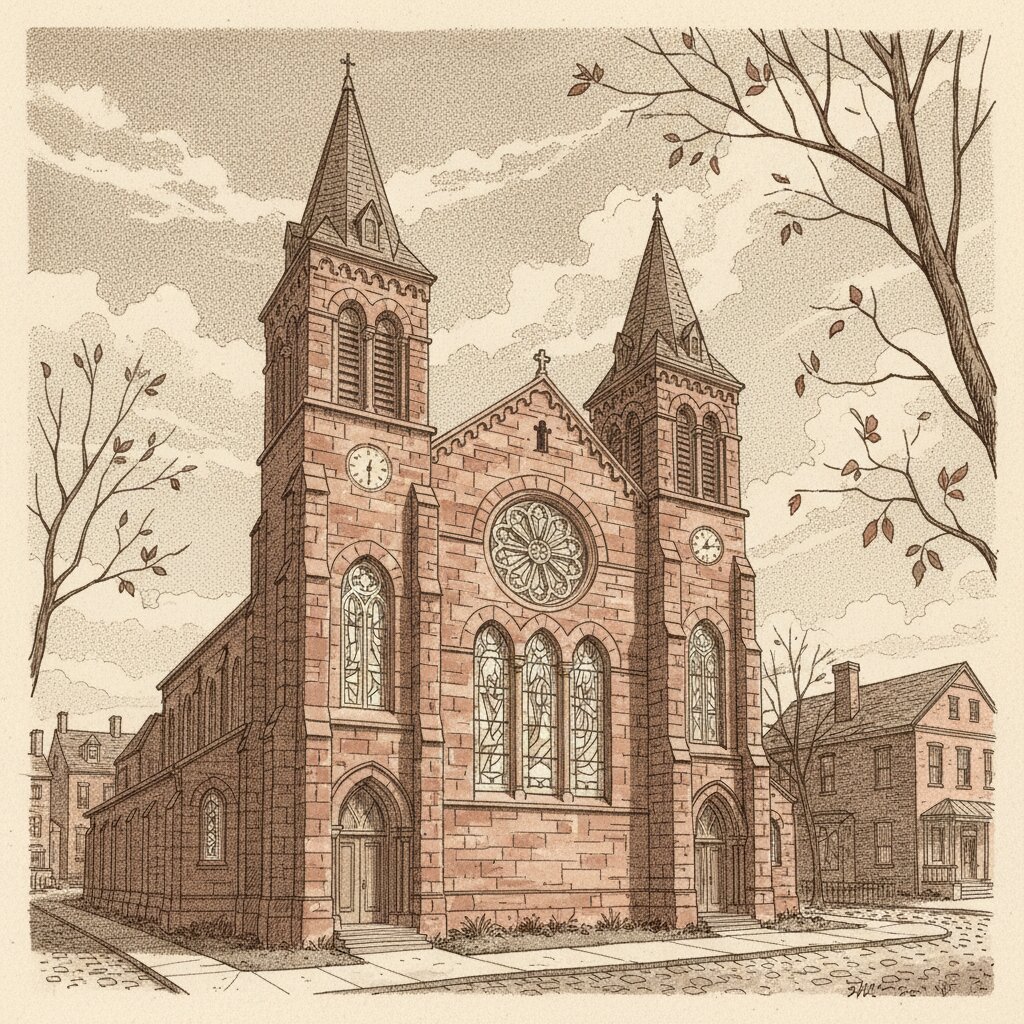
Six Detroit Catholic parishes built between 1848 and 1897 still operate in the Archdiocese of Detroit, anchoring Corktown, the East Side, and Southwest Detroit through 150 years of industrial rise and population collapse.
Six Detroit Catholic parishes built between 1848 and 1897 still hold Sunday Mass inside the Archdiocese of Detroit. Their names read as a directory of the nineteenth-century immigration waves that filled the city: Jesuit missionaries, famine-Irish labourers, Polish millworkers, Hungarian foundry workers, German meatpackers. The buildings outlived the industries that paid for them.
This piece traces the six parishes by date stone, in chronological order, so a reader visiting Detroit can see them in one afternoon and read the city's Catholic record by brick.
Saints Peter and Paul Jesuit (1848): the oldest surviving church in Detroit
Two details make this building worth the detour. The Greek Revival facade is restrained in a way the later Gothic parishes are not, a reminder that Detroit's Catholic architecture began in the same register as its early civic buildings. And the parish's present ministry, much of it to the city's homeless population, keeps the building functional rather than curated.
Most Holy Trinity, Corktown (1855–1866): the famine-Irish anchor
Construction at
Corktown has since lost most of its housing stock to expressway construction, but Holy Trinity is still a working parish of the Archdiocese of Detroit. The building's pointed-arch windows and limestone buttresses come from the Gothic Revival playbook that dominated American Catholic construction from 1850 to 1900.
Sacred Heart (1875): the French-parish holdover that went Black in the 1930s
Sacred Heart sits half a mile north of I-75. The church complex includes the convent and rectory, all three buildings in the same red-sandstone plan, and all three still in parish use.
Most Holy Redeemer (1880): once the largest Catholic parish in North America
Today Holy Redeemer is a predominantly Hispanic parish, serving the Mexican-American community that moved into Southwest Detroit after 1950. Sunday Mass is offered in Spanish and English, and the parish's neighbourhood, the West Vernor–Junction Historic District, is on the National Register. The building itself, with its twin spires visible from the Ambassador Bridge approach, is the visual signature of that district.
Sweetest Heart of Mary (1893): the Polish East-Side peak
The parish still offers a Polish-language Mass once a month. The building's 217-foot twin spires make it one of the tallest nineteenth-century structures still standing in the city.
Saint Hedwig's (1897): Detroit's second Polish cluster, west of downtown
Hedwig was a twelfth-century Silesian duchess and a patron of Polish Catholics in industrial America. American parishes named for her almost always mark the presence of a Polish or Silesian congregation at founding. Saint Hedwig's, paired with Sweetest Heart of Mary four miles east, marks the span of Polish Detroit across the 1890s.
The route, in one afternoon
The six buildings can be visited in the order above in roughly three hours by car, longer on foot. The route runs east from Saints Peter and Paul (downtown riverfront) through Corktown, up to Poletown at Sacred Heart, then west to Most Holy Redeemer and Saint Hedwig's before circling back to Sweetest Heart of Mary in the Forest Park neighbourhood. Three of the six are on the National Register, and all six remain active parishes of the Roman Catholic tradition as recorded in our Detroit directory.
Sources and further reading
- Archdiocese of Detroit — parish directory
- National Park Service — National Register of Historic Places
- Detroit Historical Society — Religion in Detroit
- Ste. Anne de Détroit Parish (founded 1701)
- Michigan State Historic Preservation Office
What to read next on Churches List
- The Michigan directory lists 5,704 parishes across the state, from the Keweenaw Peninsula to the Ohio border.
- The Catholic tradition page indexes 25,275 Catholic parishes nationwide, the third-largest tradition by parish count after Baptist and Non-Denominational.
- The Detroit city page holds 813 parishes across every tradition, with neighbourhood and denomination filters.