United States
The Episcopal Atlantic Corridor: Where the Church Stays Most Densely Concentrated
New York State alone holds more Episcopal parishes than the four colonial Anglican states combined.
The Episcopal Church USA records 8,112 parishes. The five largest state contingents — NY, CA, TX, PA, FL — together hold 32% of the national count, while the four colonial Anglican states (VA, MD, NC, SC) hold roughly 13%.
The Episcopal Church USA records 8,112 parishes in the Churches List directory. The five largest state contingents are New York (754), California (501), Texas (491), Pennsylvania (408), and Florida (397). Together they hold 32% of the national Episcopal parish count. The denomination's historic Southern Atlantic corridor — Virginia (368), Maryland (235), North Carolina (316), and South Carolina (158) — adds another 1,077 parishes, or roughly 13% of the national figure. Episcopal geography is not what a 1776 map of Anglican parishes would predict.
The colonial corridor: 1,077 Episcopal parishes in the four states of the Anglican founding
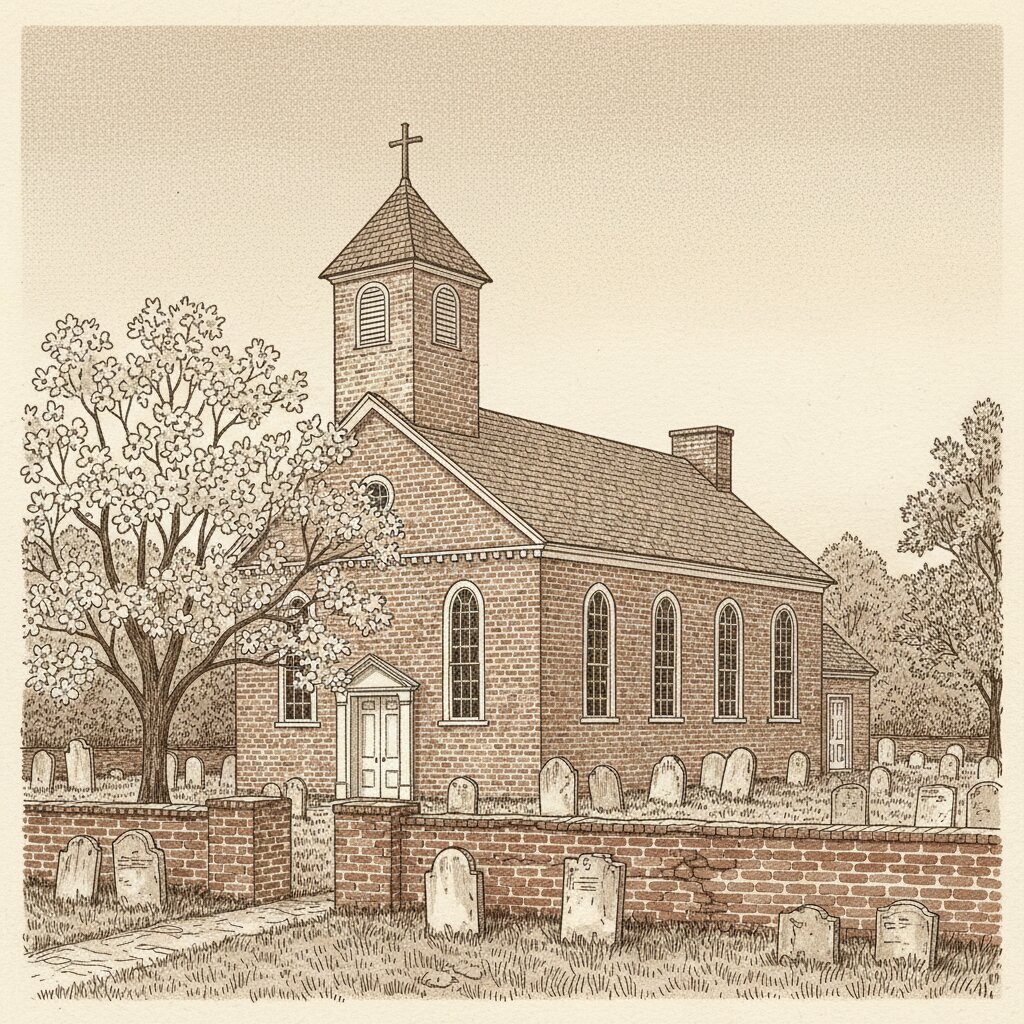
Virginia, Maryland, North Carolina, and South Carolina held the Anglican religious establishment at American independence. Maryland's 1632 charter gave the Anglican Church of England legal establishment; Virginia's 1606 Jamestown charter did the same. Both states continued Anglican establishment into the 1770s and only disestablished the church after the Revolution. The parish grid that the English colonial government laid out between 1610 and 1770 still holds, mostly. Virginia's 368 Episcopal parishes include Bruton Parish Church (1677) in Williamsburg, Pohick Church (George Washington's home parish, 1769), and Christ Church in Alexandria. Maryland's 235 parishes include St. Paul's in Baltimore (1692) and St. Anne's in Annapolis (1692). These parishes form a continuous network from Chesapeake Bay to the Carolina low country.
Why New York holds more Episcopal parishes than any colonial Anglican state
New York's 754 Episcopal parishes are more than double Virginia's 368, even though New York was never an Anglican-establishment colony. The gap reflects nineteenth-century growth rather than colonial inheritance. The Diocese of New York absorbed the upstate growth of the Erie Canal and the Buffalo-Rochester-Syracuse corridor between 1825 and 1890, adding roughly 300 parishes in the period. The Diocese of Long Island (split from New York in 1869) added another 130. By 1900, New York's Episcopal parish count exceeded any Southern state's.
California, Texas, and Florida: the postwar growth corridor
California's 501 Episcopal parishes, Texas's 491, and Florida's 397 are largely post-1945 plantings. The Episcopal Church's demographic strategy after World War II focused on suburban expansion, and California and Texas suburbanization produced the largest opportunities. The Diocese of Los Angeles (147 parishes) is the largest Episcopal diocese by parish count outside the New York metro.
Texas's Episcopal presence splits across five dioceses: Texas (the Houston-Austin corridor), Dallas, Fort Worth, West Texas, and Rio Grande. Fort Worth's diocese disaffiliated from the Episcopal Church in 2008 in the conservative wing's split, and the property dispute took until 2021 to resolve in favour of the continuing Episcopal Diocese of Fort Worth. The Anglican Diocese of Fort Worth (affiliated with the Anglican Church in North America, not the Episcopal Church) retains a parallel parish grid in the same territory.
The 2003 realignment: how the Episcopal parish count shifted
The Episcopal Church's 2003 consecration of Gene Robinson, the first openly gay bishop in Anglican history, triggered a decade of parish departures. Roughly 700 Episcopal parishes left the denomination between 2006 and 2012. Most joined the Anglican Church in North America (ACNA), which now holds about 950 US parishes. The departures were concentrated in the former Anglican Diocese of Pittsburgh, the Anglican Diocese of Fort Worth, the Anglican Diocese of South Carolina, and the Anglican Diocese of San Joaquin. Our Episcopal tradition page indexes parishes affiliated with either the Episcopal Church or the Anglican Church in North America, following each parish's self-identification.
The historical Episcopal presence in Pennsylvania and the mid-Atlantic
Pennsylvania's 408 Episcopal parishes and New Jersey's 326 reflect a nineteenth-century mid-Atlantic Anglican presence that was not colonial-establishment-based but that grew from Philadelphia's eighteenth-century Anglican merchant class. Christ Church in Philadelphia (1695) is the oldest continuously-operating Anglican parish in the mid-Atlantic and served George Washington, John Adams, and Benjamin Franklin, who is buried in its churchyard. Philadelphia's 20 Episcopal parishes include Christ Church, St. Peter's (1761), and the African Episcopal Church of St. Thomas (1792, the first Black Episcopal parish in the United States).
Where Episcopal density is low: the Gulf Coast and the Mountain West
Mississippi (90 Episcopal parishes), Alabama (170), Louisiana (146), and Arkansas (60) together hold roughly 5.7% of the national Episcopal count despite comprising a meaningful share of the US population. The Mountain West (Idaho 41, Montana 55, Wyoming 32, Nevada 34, Utah 26) adds another 188. The combined Gulf Coast and Mountain West Episcopal presence is 654 parishes, less than New York State alone. The Episcopal Church is, by national parish distribution, concentrated on the two coasts and in the Great Lakes.
Sources and further reading
- The Episcopal Church
- Anglican Church in North America (ACNA)
- Virginia Theological Seminary
- Bruton Parish Church, Williamsburg (1674)
- Archives of the Episcopal Church
What to read next on Churches List
- The Episcopal tradition page indexes every Episcopal and ACNA-affiliated parish nationally.
- The Virginia, Maryland, North Carolina, and South Carolina directories for the colonial Anglican corridor.
- The Baptist–Lutheran Inversion for the other major American Protestant geographic split.