Chicago, Illinois
Why Chicago's 1,875 Parishes Outnumber Any Midwestern City — and Which Denominations Hold the Grid
Baptist, Catholic, and Non-Denominational congregations fill the first, second, and third places in Chicago's Sunday record.
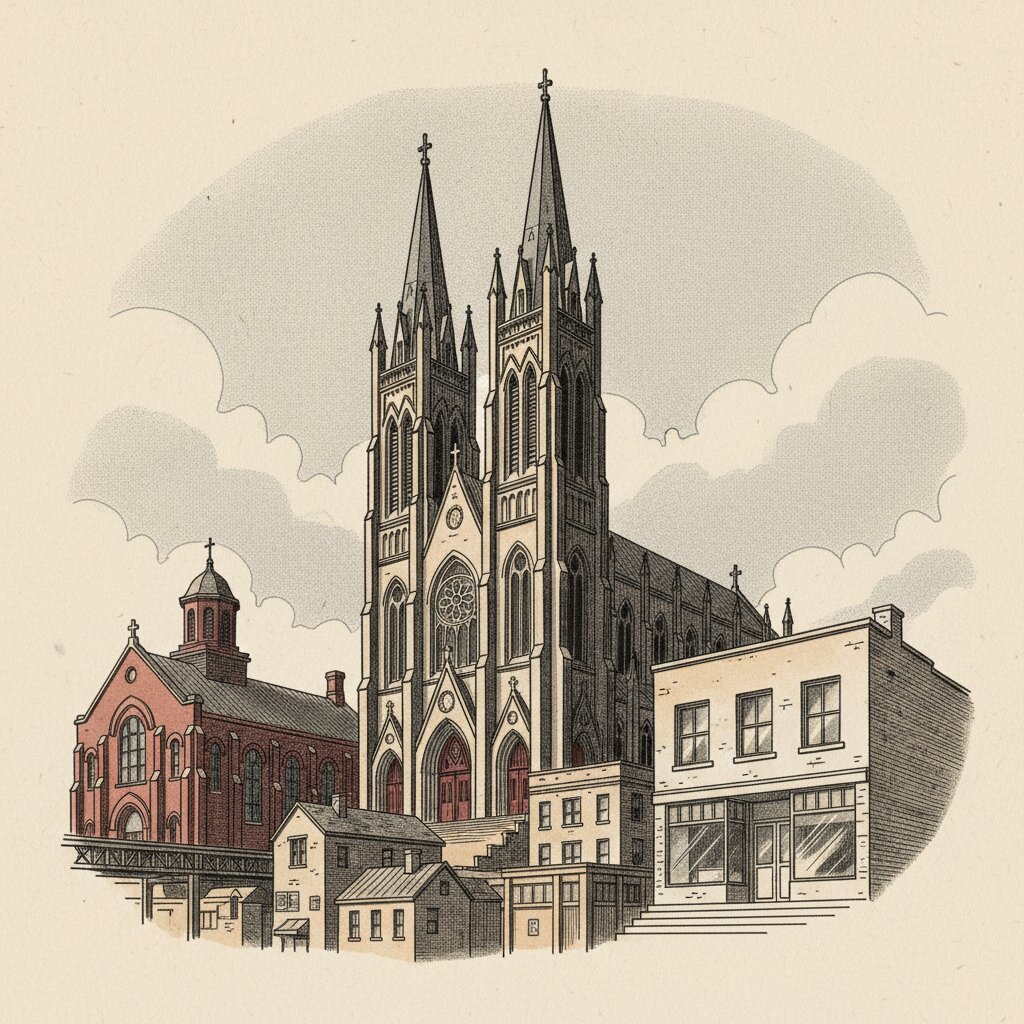
Chicago holds 1,875 parishes inside the city limits, the highest count of any Midwestern city: 347 Baptist, 251 Catholic, and 232 Non-Denominational congregations anchor a grid shaped more by the Great Migration than by Chicago's income map.
Chicago holds 1,875 parishes inside the city limits, the highest parish count of any Midwestern city in the Churches List directory. Baptist congregations lead the roster (347), followed by Roman Catholic (251), Non-Denominational (232), and Baptist Missionary Association of America (160). The grid is the city's rail logic applied to Sunday morning: ethnic neighbourhoods deposited churches, and the churches outlasted the industries that filled them.
The Baptist plurality: 347 congregations clustered on the South and West Sides
Baptist churches form the largest tradition in Chicago. Two factors account for the 347 figure: the Baptist Missionary Association of America alone lists 160 congregations inside the city, and the mainstream Baptist tradition lists another 347 recorded under the umbrella Baptist category. Together they trace the Great Migration's map, from Englewood and Bronzeville westward.
The Roman Catholic grid: 251 parishes and a consolidation century
Chicago's 251 Catholic parishes reflect a Roman Catholic Archdiocese that, at its 1950s peak, had more than 450 parishes inside the city. The 40% decline since reflects the Chicago Archdiocese's "Renew My Church" consolidations, which merged ethnically-specific national parishes into territorial parishes through the 1990s and 2010s.
Two of Chicago's Catholic parishes hold the "basilica" designation:
The Non-Denominational surge: 232 congregations, almost none older than 1980
Chicago's 232 Non-Denominational parishes are the third-largest tradition block and the youngest as a cohort. The Non-Denominational tradition page lists 35,730 such congregations nationally, more than any other tradition except Baptist, and Chicago's share is modest because the city's Baptist and Catholic grids absorbed most of the independent-evangelical flow before the 1980s.
The Black church tradition: Salem, Trinity, Sabina, Fourth
The Black church tradition in Chicago runs along a four-point line: Trinity UCC on 95th Street,
The Lutheran memory: 97 congregations in a German grid that was once German-only
Chicago's 97 Lutheran congregations are a smaller share than the city held in 1900, when the North Side was a majority-German quarter with Lutheran-language parishes on nearly every rail stop. Most of those buildings stood, but many merged into English-language parishes through the 1950s or were sold to Asian-language congregations in the 1980s.
Eight neighbourhoods hold the densest parish counts
The top eight Chicago neighbourhoods by parish count (derived from our address-city + ZIP clustering): Austin, Englewood, Humboldt Park, Roseland, South Shore, Lawndale, Pilsen, and Auburn Gresham. Six of the eight are majority-Black; one (Pilsen) is majority-Latino; one (Humboldt Park) is mixed Latino and Black. The neighbourhoods with the highest per-capita income in Chicago (Lincoln Park, Lakeview, the Loop, the Near North) do not appear in the top eight for parish density; those neighbourhoods have fewer, larger congregations rather than many small ones.
Sources and further reading
- Archdiocese of Chicago
- Moody Bible Institute
- Chicago History Museum — Religious Life
- Old St. Patrick's Church
- Trinity United Church of Christ
What to read next on Churches List
- The Illinois directory holds 6,820 parishes statewide, with Cook County holding nearly half.
- The Catholic tradition page indexes every Catholic parish in the Archdiocese of Chicago.
- The Baptist tradition page and Non-Denominational tradition page are the two largest traditions in American Protestant life.