Brooklyn, New York
Brooklyn's 863 Parishes by Neighbourhood: Sunday Morning in the Most Densely Churched Borough
Twelve parishes per square mile, stacked vertically in immigration-era layers from 1650 to 2000.
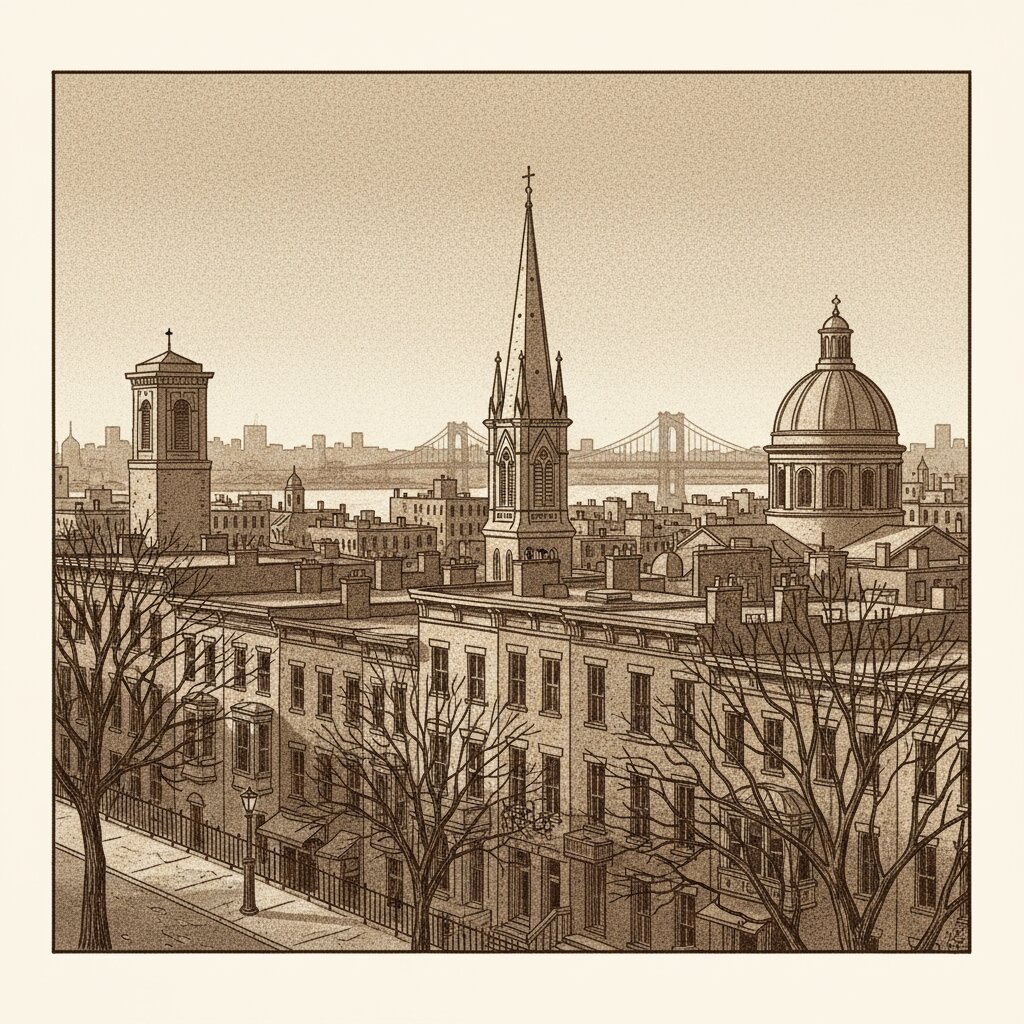
Brooklyn holds 863 parishes inside its borders, 12 per square mile, stacked in layers from the Dutch Reformed of the 1650s to the Fujianese evangelical congregations of the 2000s. Every neighbourhood is a different Sunday morning.
Brooklyn holds 863 parishes inside its borders, the highest parish count of any New York City borough and the highest parish-per-square-mile count of any American jurisdiction of comparable size. Brooklyn's 70 square miles hold roughly 12 parishes per square mile, a density that outpaces Manhattan (not the per-capita rate but the per-area rate), Chicago, and every other American metro. The neighbourhoods that hold the densest parish counts are almost all twentieth-century immigrant-era neighbourhoods: East Flatbush, Crown Heights, Bedford-Stuyvesant, Sunset Park, Bushwick, Bensonhurst.
Bedford-Stuyvesant and Crown Heights: the Black Baptist and AME grid
Bedford-Stuyvesant and Crown Heights hold the highest parish density in the borough, most of it Baptist, AME, AME Zion, Church of God in Christ, and Pentecostal. The neighbourhoods absorbed much of the Great Migration into Brooklyn between 1915 and 1970, and the resulting church grid is tight: a parish every block or two on Fulton Street, Nostrand, Bedford, and Eastern Parkway.
Sunset Park: Chinese, Mexican, and Norwegian layers stacked on the same streets
Sunset Park holds three distinct parish grids on top of each other. The Norwegian Lutheran and Reformed parishes from the 1890–1940 Brooklyn Norwegian enclave (Lapskaus Boulevard) sit on Fifth Avenue and Fourth. The Mexican Catholic parishes planted from 1990 forward, many of them with Our Lady of Guadalupe devotions, sit on Fifth and Sunset Park itself. The Fujianese and Cantonese evangelical congregations that filled Eighth Avenue after 2000 added a third layer. Three of the four largest Norwegian Seamen's Church parishes in the United States were in Sunset Park before the 1970s; two remain.
Bensonhurst and Bay Ridge: the Italian Catholic anchor
Bensonhurst and Bay Ridge hold the largest cluster of Italian-origin Catholic parishes in the five boroughs. The Diocese of Brooklyn maintains St. Athanasius, St. Dominic, St. Finbar, and St. Philip Neri parishes in Bensonhurst alone; Bay Ridge holds St. Anselm and Our Lady of Angels. Bensonhurst's parish grid dates to the 1900–1930 Italian migration that displaced an earlier Norwegian population west to Sunset Park. The 2000s Chinese and Hispanic in-migration has added Spanish-language Mass times at several of the Italian-founded parishes.
Flatbush and East Flatbush: Caribbean Protestant and Catholic
Flatbush and East Flatbush hold one of the densest Caribbean-origin parish grids in the United States. Haitian Catholic parishes, Jamaican and Trinidadian Pentecostal parishes, Seventh Day Adventist congregations (the Caribbean Protestant identity overlaps heavily with Adventism), and Baptist parishes founded by Caribbean migrants sit on nearly every ten blocks. Flatbush alone has more than 60 parishes in a 3.1-square-mile area. The Bedford-Stuyvesant / Crown Heights / Flatbush triangle holds roughly 340 of Brooklyn's 863 parishes inside a 9-square-mile footprint.
Greenpoint and Williamsburg: Polish Catholic and Hasidic boundary parishes
Greenpoint holds what is arguably the largest Polish-language Catholic parish population outside Poland. The six Polish national parishes in Greenpoint (and adjoining Williamsburg, north of the Williamsburg Bridge) serve a community that has recovered from its 1990s post-communist peak and that still offers Polish-language Sunday Mass at six places within a one-mile radius. On the Williamsburg side, the parishes border the large Satmar Hasidic community that sits south of the Williamsburg Bridge — a neighbourhood with essentially no Christian parishes but more than 100 Jewish houses of worship.
Park Slope and Brooklyn Heights: the historic mainline Protestant grid
Park Slope, Brooklyn Heights, and Boerum Hill hold the older Episcopal, Presbyterian, and Congregational parishes founded between 1820 and 1880 for the Brooklyn professional class.
Saint Laurence and the John Wesley Methodist node
Sources and further reading
- Diocese of Brooklyn
- Plymouth Church of the Pilgrims (Henry Ward Beecher)
- New Utrecht Reformed Church (1677)
- Brooklyn Historical Society — Center for Brooklyn History
- Reformed Church in America
What to read next on Churches List
- The Brooklyn city page holds all 863 parishes by tradition and neighbourhood.
- The New York directory and The Catholic Parish Network of New York State for the upstate and statewide Catholic context.